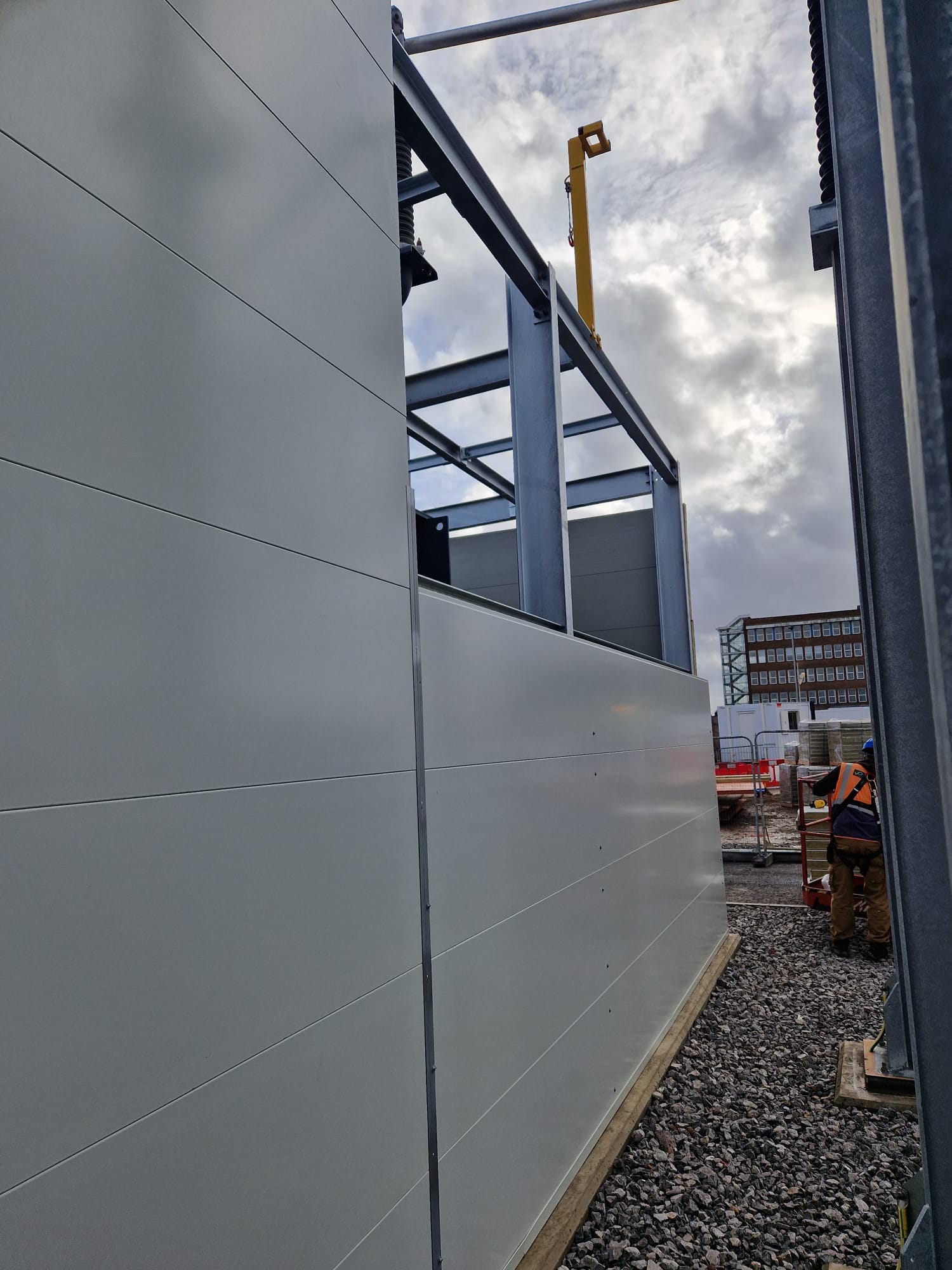
How do acoustic barriers work?
The theory behind the question ‘how do acoustic barriers work?’ is based on decades of research into acoustics by various institutes.
Decibels
Noise is measured in decibels, dB, as sound pressure level. You will often see it expressed as dBA or dB (A), which refers to sound levels perceived by human ears.
Decibel levels vary on a logarithmic scale, ranging anywhere from 0-194dB, a normal conversation between two people is about 60dB whereas a rocket launch registers as high as 150dB. A change of 10dBA is perceived as the sound level halving or doubling.
Frequency
One problem with noise-mitigating measures is that sound behaves differently at different frequencies. Frequency is what musicians call pitch. Low frequencies are perceived as ‘bassy’ which often have the tendency to ‘curve’ around screens , where high frequencies sound sharp often reflecting or ‘beam’ over screen.
Noise Assessments & Sound Surveys
Depending on the project a type of noise assessment is usually selected, using various methods an acoustic consultant can determine noise levels in the environment and specify the noise level reduction required by a suitable noise mitigation product. This input ensures that acoustic product manufacturers (like AGS!) can produce a corresponding solution which meets or exceeds that criteria. Often the specification is expressed as an Rw or by stating that the barrier must meet a certain minimum mass & have an interior absorbent face.
Design
It is important that barrier design is sufficient to meet the requirements of the project and environment. Best practice is to design a barrier which just exceeds the requirements set out in the Noise Report. This must take into account that in the real world sound can travel around or over the barrier to the receiver, which makes placement critical, and environmental factors such as temperature gradient, wind, and season can degrade the performance of a barrier. Often overlooked is the final appearance, colour and finish play a large role in the noticeability of an acoustic wall. The final piece of the puzzle, is longevity. Acoustic barriers constructed in external environments must have enhanced corrosion resistance to ensure they do not degrade over time and the structural and acoustic integrity of the barrier is maintained.
Airflow to the equipment being surrounding is critical in some cases, such as ASHP’s, AHU’s and chillers. When the level of acoustic performance required means that the equipment will be starved of airflow by a solid barrier, additional design consideration must be made. Typically acoustic louvres, with exceptional acoustic performance, will replace a section of the barrier to allow airflow whilst maintaining acoustic performance.
Construction
Construction of acoustic barriers varies vastly. AGS Noise Control’s barriers, are typically formed from galvanised steel with a mildew, vermin, mould resistant mineral wool infill. The interior face of the steel is often perforated giving the panels a Class ‘A’ absorption rating. This reduces sound reflections travelling back towards the source as well as reducing reverberation times within a space.
Installation
A determining factor for a noise barrier’s capability to reduce noise is sealing. Noise passes directly through an unsealed barrier. Long and narrow openings, such as gaps along the ground or between the screen sections degrade the quality of the screen significantly. It is imperative that acoustic screen installers be experienced and achieve tight tolerance when erecting the structure.
Maintenance
Usually rain does the job but if not you can gently remove loose impediment with water and a soft brush.
AGS can help with all of the above, from acoustic barrier design to supply and installation.
Check out our full range of acoustic barriers and capabilities here. High Performance Acoustic Barriers | AGS Noise Control Ltd